


Most advice on winning cleaning contracts is a list of places to cold call. This is the other half of the picture: how the buyers actually find and shortlist cleaning companies in 2026, and how to be the company they find.
Key Takeaways
- Four buyers hand out most of Melbourne’s commercial cleaning work: office and property managers, FM panels, builders, and tenders.
- The demand is measurable: about 4,400 monthly searches for “office cleaning melbourne”, and companies pay up to $30 a click for them.
- Most searchers never scroll past the map pack. If you are not in the box for your area, the enquiry goes to someone who is.
- The review bar is a median of just 20 among top-3 results, and a simple ask-and-reply system beats it.
- Do the five moves in order: profile, reviews, service pages, listings, then outbound. Every channel feeds the others.
Who actually gives out cleaning contracts
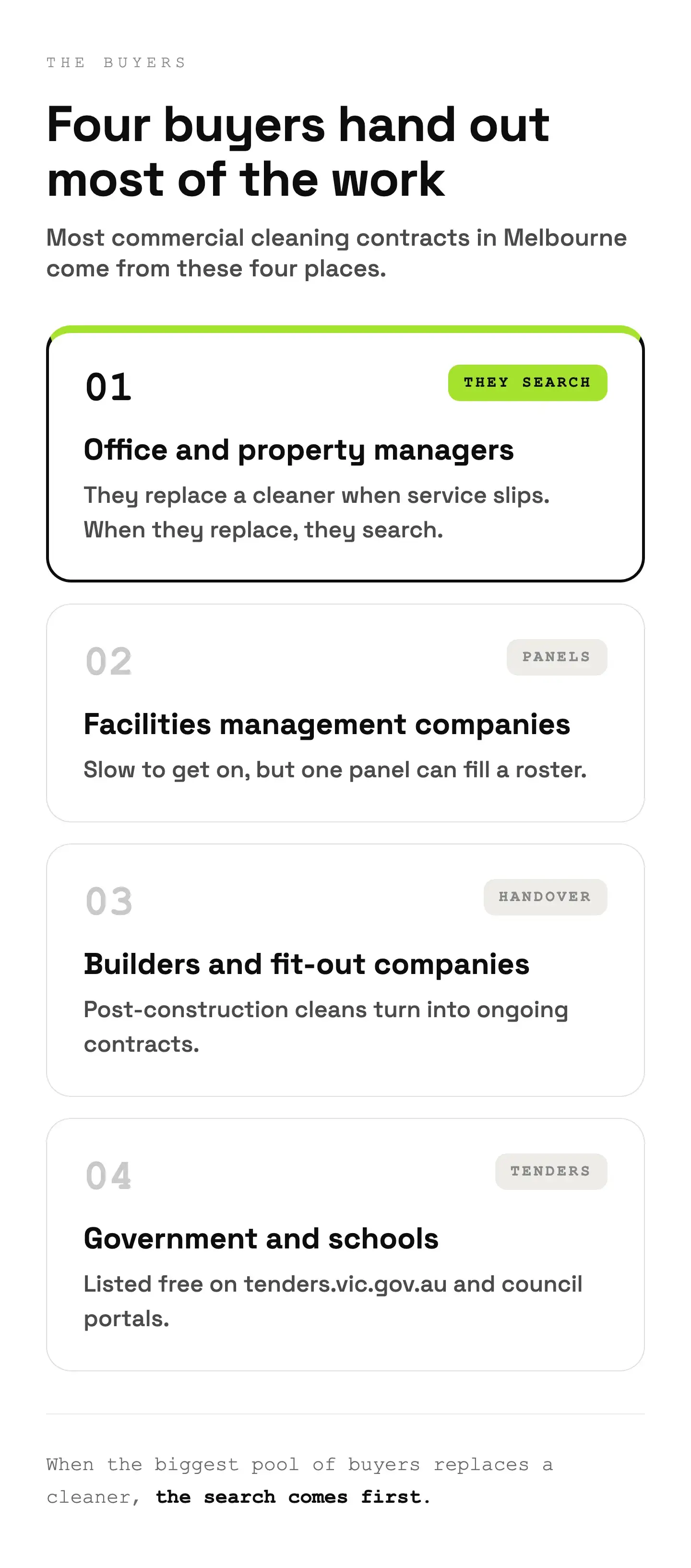
Four buyers hand out most of the commercial cleaning work in Melbourne:
- Office and property managers. The biggest pool. They inherit a cleaner with the building and replace them when service slips. When they replace, they search.
- Facilities management companies. They subcontract. Getting on their panel is slow, but one panel can fill a roster.
- Builders and fit-out companies. Post-construction cleans lead to ongoing contracts more often than people think. The builder hands over the building, the client asks who cleaned it.
- Government and schools. Tenders. Slow, paperwork-heavy, price-driven, but public: tenders.vic.gov.au and local council portals list them for free.
Cold calling and tenders are covered to death elsewhere. The channel most cleaning companies ignore is the one below, and it’s measurable.
The numbers nobody shows you
People in Melbourne search “office cleaning melbourne” about 4,400 times a month, and “commercial cleaning melbourne” about 1,900 times. Cleaning companies pay Google up to $30 a click to appear for those searches. That’s the market telling you what one enquiry is worth.

Here’s the part that matters: most of those searchers never scroll past the map pack, the three businesses Google shows with reviews and a call button. If you’re not in that box for your area, the searcher hires someone who is, and you never know the enquiry existed.
A contract you never got to quote on does not feel like a loss, and that is exactly what makes invisibility so expensive.
Alex Caceres, Managing Director, Threefold Systems
What decides the map pack
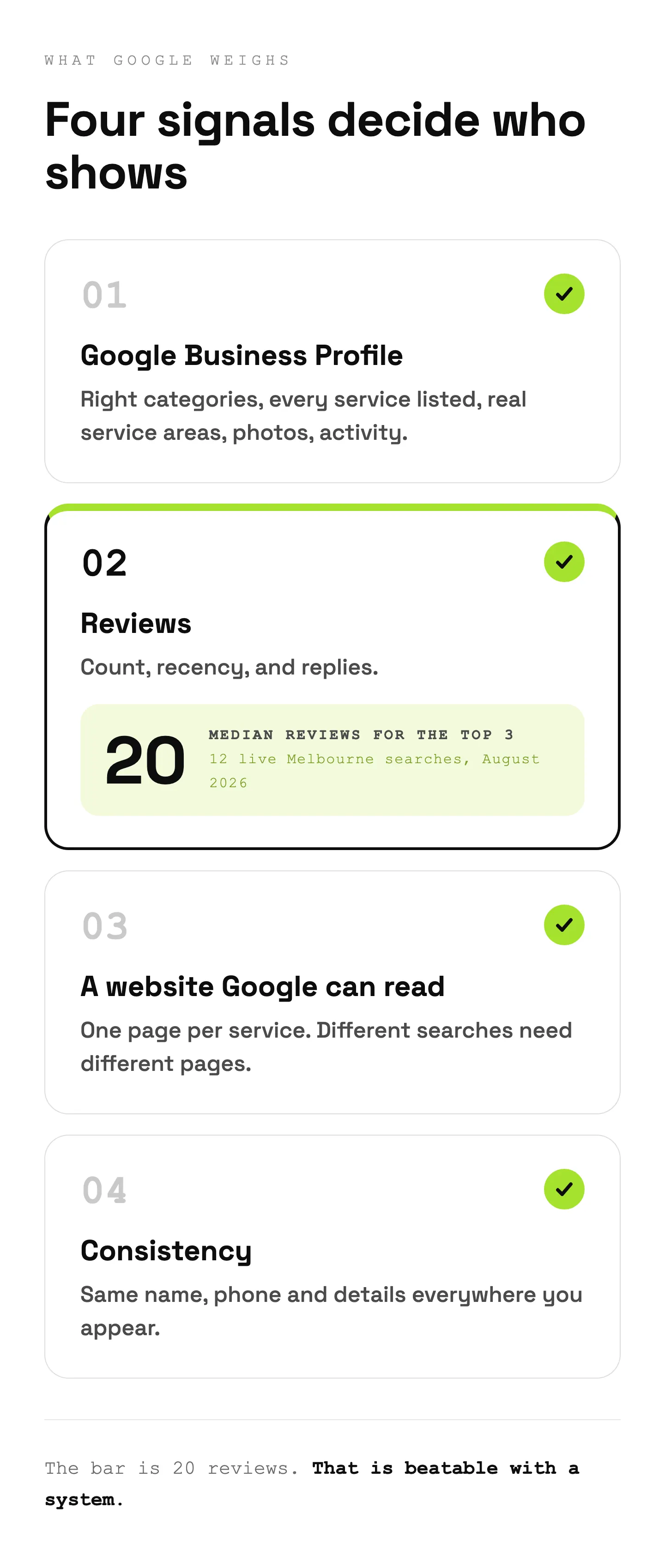
Google picks those three from signals you control. We’ve written a full guide to how the map pack ranks; the short version for a cleaning company:
- Your Google Business Profile. Right categories, every service listed, real service areas, photos, and activity. A profile set up once in 2021 and left alone is invisible.
- Reviews. Count, recency, and replies. We measured this in August 2026: across 12 live Melbourne searches, the businesses consistently ranking top 3 held a median of just 20 Google reviews. That’s the bar, and it’s beatable with a system: ask every happy client, every time, and reply to every review.
- A website Google can read. One page per service you offer. “Commercial cleaning” and “medical centre cleaning” and “end of lease cleaning” are different searches. One “our services” page can’t rank for all of them.
- Consistency. Same business name, phone and details everywhere your company appears online.
None of this is a trick. It’s maintenance work that compounds, which is exactly why the companies who do it keep winning: their competitors won’t.
The 5 moves, in order
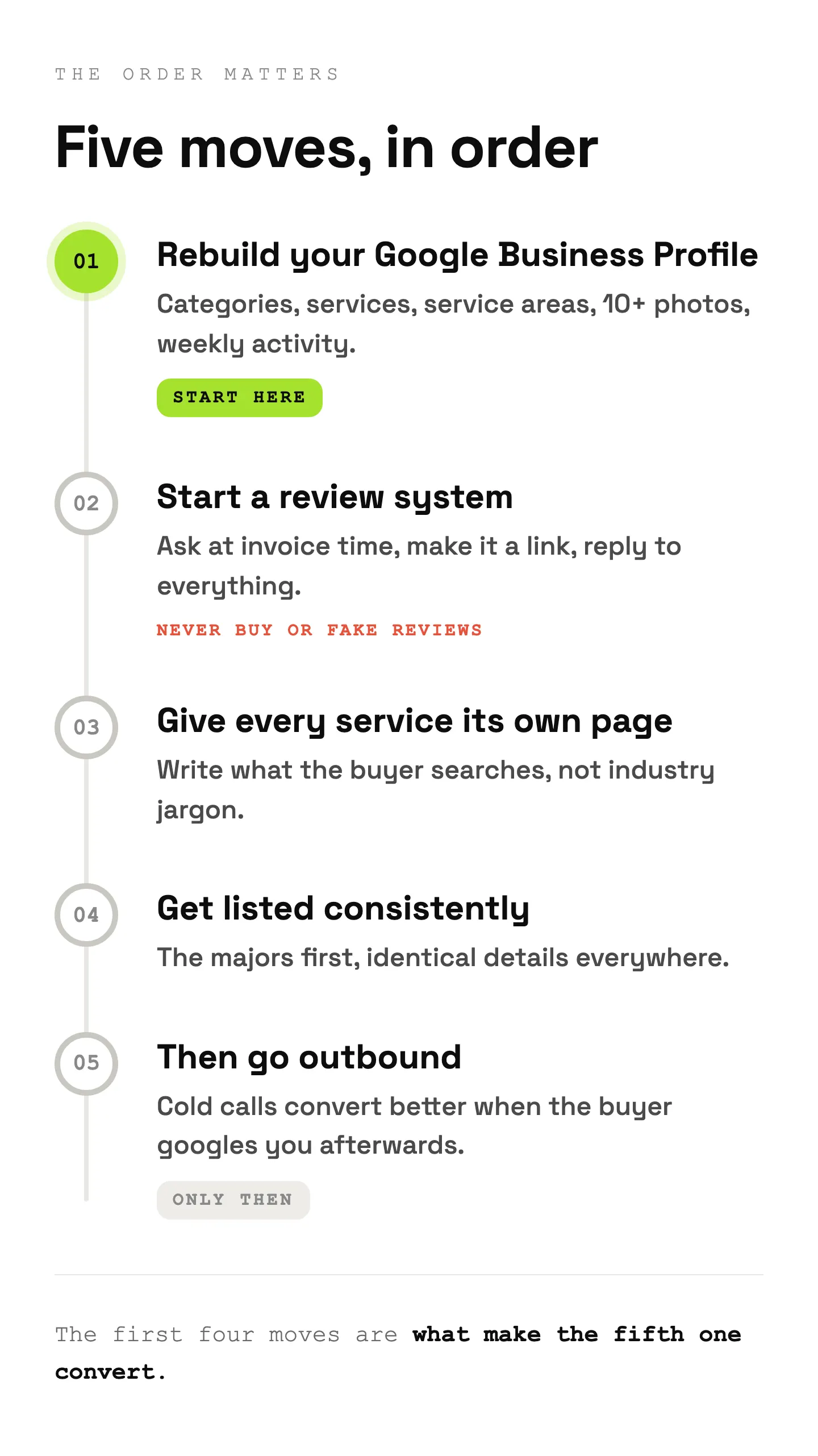
- Rebuild your Google Business Profile properly. Categories, services, service areas, 10+ photos, weekly activity. An afternoon of work that most competitors never do.
- Start a review system this week. Ask at invoice time, make it a link, reply to everything. Never buy or fake reviews; profiles get suspended for it.
- Give every service its own page. Start with the contract types you want more of. Write what the buyer searches, not industry jargon.
- Get listed consistently. The majors first, identical details everywhere. Keeping all of this maintained week after week is the job of an ongoing local SEO campaign.
- Then go outbound. Cold calls and tender applications convert better when the buyer googles you afterwards and finds a strong profile, real reviews, and a professional site. Every channel feeds the others.
Ownership
Do it yourself, or don’t
Everything above is doable in-house if someone owns it every week. That’s the honest catch: none of it is hard, but all of it is constant, and someone has to own it.
If nobody in your company is going to own it, that’s the work we do. Threefold runs exactly this system for commercial cleaning companies: from $2,000 a month, no lock-in, rankings tracked weekly, and more leads in 90 days or we work free until you get them. Prices are public on our pricing page.
FAQ
How do I get commercial cleaning contracts in Melbourne?
Four buyers hand out most of the work: office and property managers, facilities management panels, builders, and government tenders. Managers search when service slips, so the fastest lever is being the company they find: a complete Google Business Profile, steady reviews, and a page for each service you want more of. Then go outbound, because cold calls convert better when the buyer googles you and finds a strong presence.
How much is a commercial cleaning lead worth in Melbourne?
The market prices it for you. Cleaning companies pay Google up to $30 a click for searches like “office cleaning melbourne”, which runs about 4,400 times a month. A click is not a contract, but that is what companies pay just for the chance to quote, which tells you what one enquiry is worth.
How many Google reviews does a cleaning company need to rank?
Across 12 live Melbourne searches we measured in August 2026, the businesses consistently ranking top 3 held a median of just 20 Google reviews. That is the bar, and it is beatable with a system: ask every happy client at invoice time, make it a one-tap link, and reply to every review.
Are tenders worth it for cleaning contracts?
They are public and free to find on tenders.vic.gov.au and local council portals, but slow, paperwork-heavy and price-driven. Treat them as one channel of several, and remember that buyers google you after you apply, so your profile, reviews and website still decide plenty of the outcome.