


When someone in your suburb searches “plumber near me” or “cafe fitzroy”, the first thing they see is not a website. It is the little map with three businesses pinned under it. That box is called the local pack, and for most local businesses it is where the phone calls come from. Forget ranking “on Google” in some general sense; the job is getting into that box.
None of it is a mystery, and most of it you can start on this week.
Key Takeaways
- Google ranks the map pack on three things: proximity, relevance and prominence, and only the last two can be moved.
- Most profiles are simply unfinished. Specific categories, every service listed and fresh photos give Google something to match against.
- Reviews are the prominence lever, and the bar is lower than owners assume: across 12 live Melbourne searches, top-3 businesses held a median of just 20.
- Keep your name, address and phone number identical everywhere, down to “St” versus “Street”.
- Nobody can buy the organic map pack or guarantee #1. Expect movement in 6 to 8 weeks and bigger gains over 3 to 4 months.
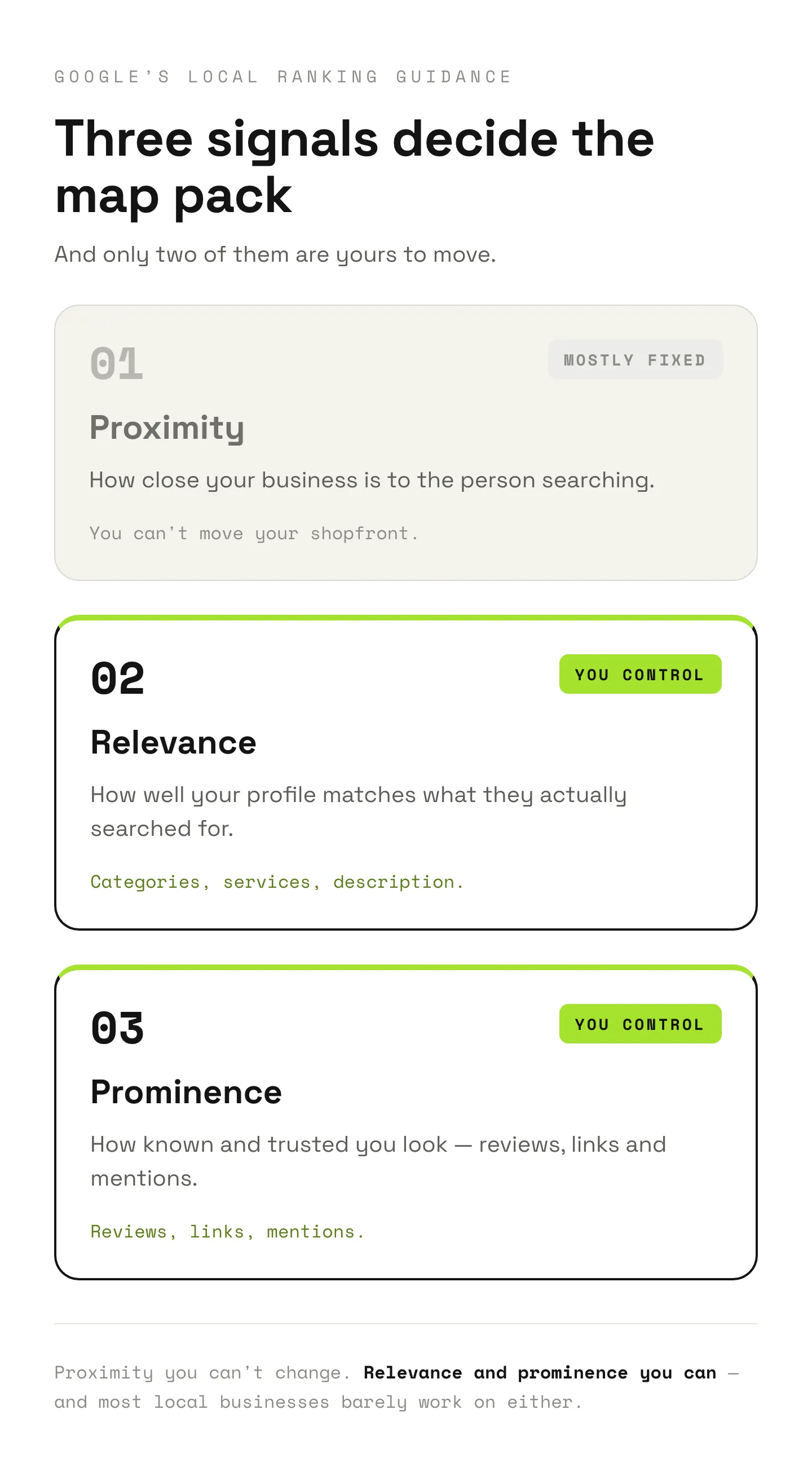
Google ranks the map pack on three things
Google is unusually open about this one. Its own local ranking guidance names three factors:
- Proximity. How close your business is to the person searching.
- Relevance. How well your profile matches what they searched for.
- Prominence. How well known and trusted your business looks, mostly through reviews, links and mentions.
The trick is knowing which of these you can move. You cannot pick up your shop and move it closer to every searcher, so proximity is mostly fixed. That leaves relevance and prominence, and the good news is that most local businesses barely work on either. There is a lot of ground to take.
Fix your Google Business Profile first
Your Google Business Profile (GBP) is the free listing that feeds the map pack. Before anything clever, get the basics right, because Google reads them directly for relevance.
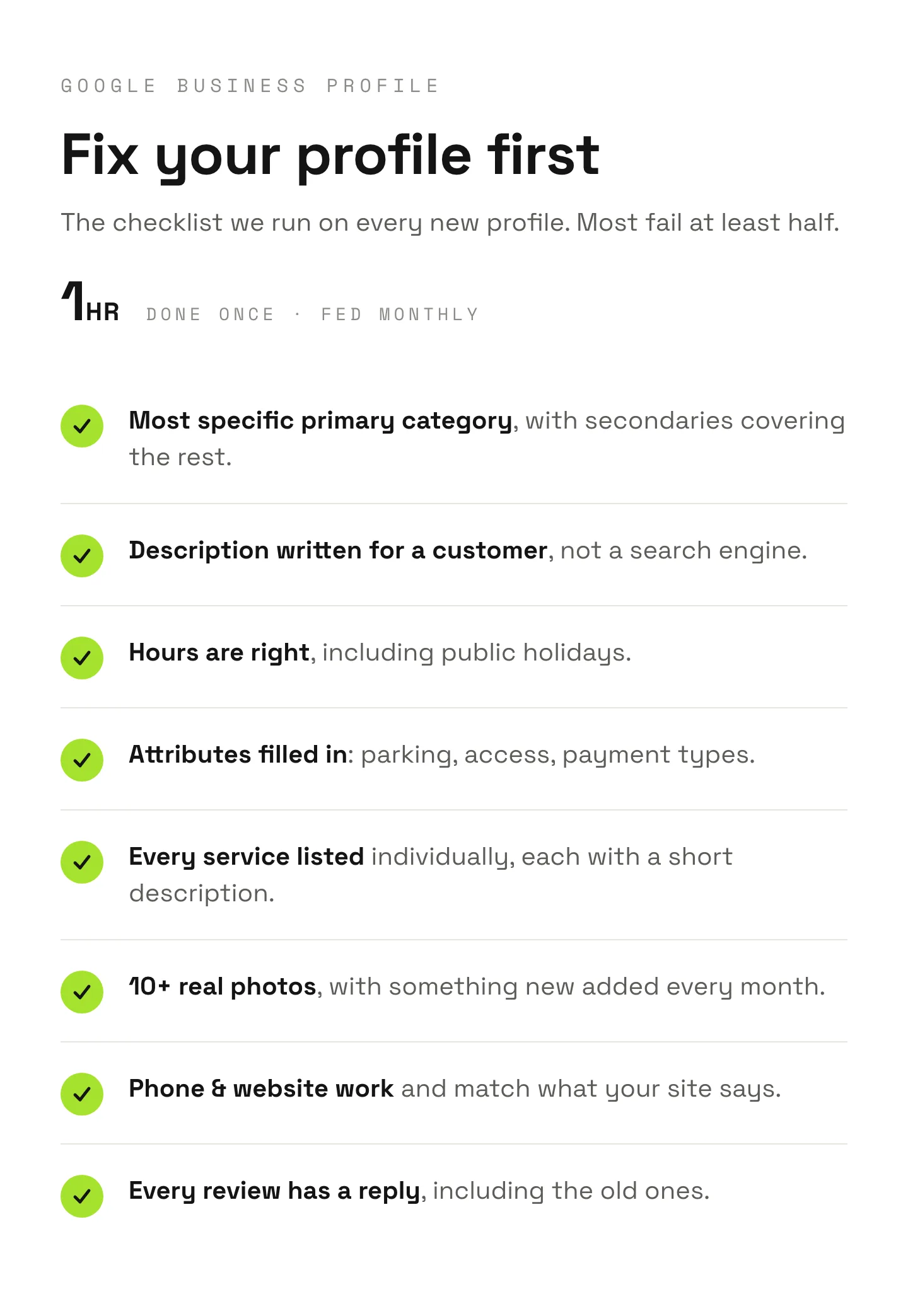
- Pick the most specific primary category that fits. “Emergency plumber” beats “plumber” if that is what you want to rank for, and secondary categories cover the rest of what you do.
- Use your real business name. Do not stuff keywords into it: Google can suspend you for it, and it is the fastest way to undo everything else.
- List every service in plain words, the way a customer would say it, and write the description for a person who is deciding whether to call.
- Add real photos of your work, your team and your storefront, and keep adding them. Profiles with fresh photos look active and get more clicks.
- Keep your hours, phone number and website link accurate. A wrong opening time is a lost customer and a trust hit.
None of this is hard. Most businesses just never finish it, which is exactly why finishing it moves you up.
If you want a finish line to aim at, this is the checklist we run on every new profile. It takes about an hour, and most profiles we look at fail at least half of it.
Take two electricians in the same suburb. One set their category to “Electrician” years ago, uploaded four photos, and has not touched the profile since. The other lists “Emergency electrician” as a secondary category, has every service spelled out, and adds photos from real jobs each month. When someone nearby searches “emergency electrician”, Google has plenty to match against on the second profile and almost nothing on the first. Same suburb, same trade, and the map pack picks the profile that gave Google something to work with. The gap is administrative, not magical.

You cannot move your shop closer to every searcher. Relevance and prominence are the whole game, and most businesses barely work on either.
Alex Caceres, Managing Director, Threefold Systems
Reviews are the prominence lever
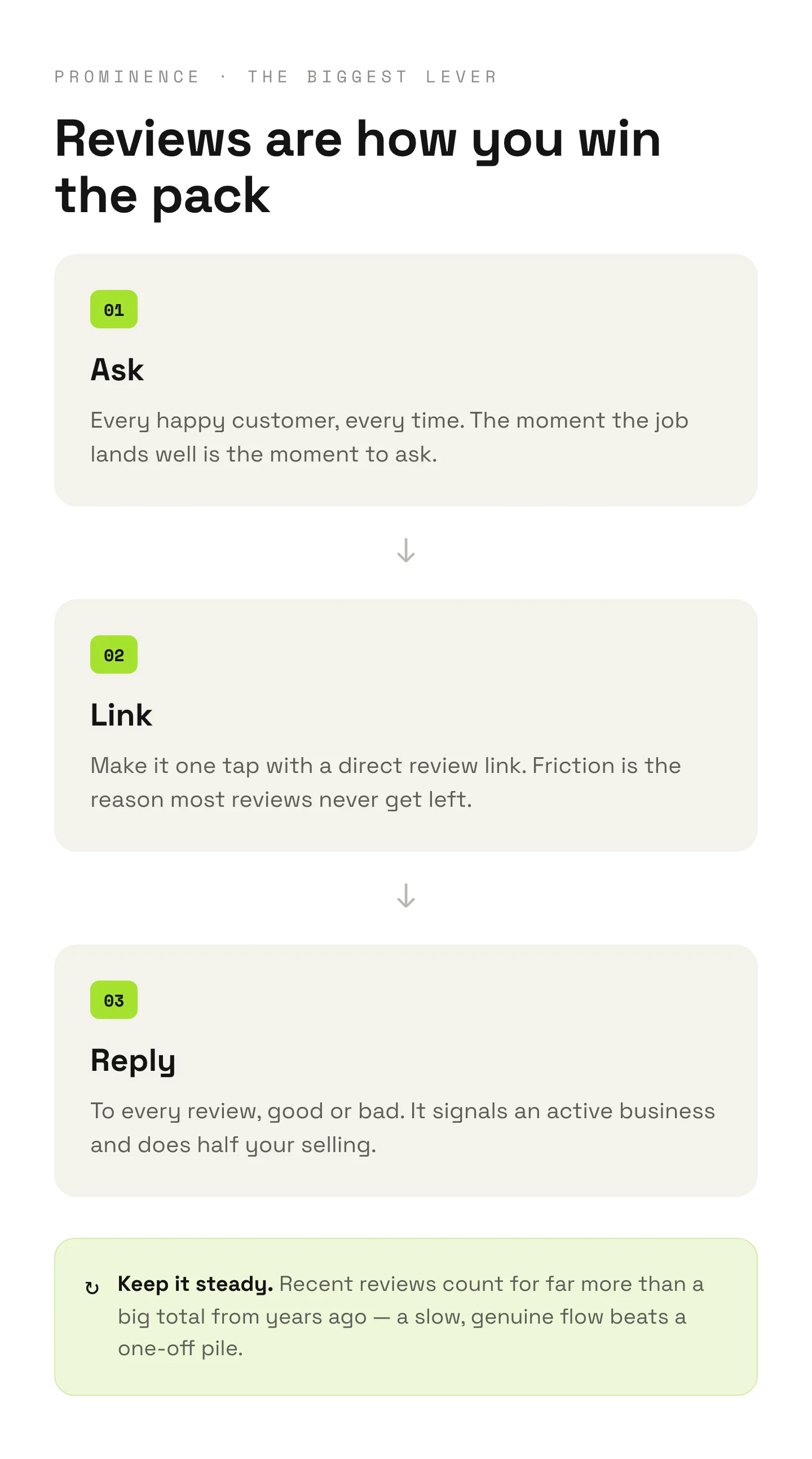
Prominence is where the map-pack fight is usually won or lost, and reviews are the biggest part of it. A steady flow of genuine reviews tells Google your business is active and worth showing. They also do half your selling before the customer even clicks: BrightLocal’s Local Consumer Review Survey found that 97% of consumers read reviews for local businesses, and that recent reviews count for far more than a big total from years ago.
The pattern that works is simple: ask every happy customer, make it easy with a direct link, and reply to every review, good or bad. We wrote the full playbook in how to get more Google reviews, because it is worth doing properly rather than in a panic. And the bar is lower than most owners assume: when we measured 12 live Melbourne cleaning searches in August 2026, the businesses consistently ranking top 3 held a median of just 20 reviews. We break that down in how to get commercial cleaning contracts in Melbourne.
Consistency
Keep your name, address and phone identical everywhere
This one is boring and it matters. Your name, address and phone number (the industry calls it NAP) should be written exactly the same way on your website, your GBP, and every directory you appear in. If your address says “St” in one place and “Street” in another, you are making Google work out whether it is looking at one business or two. Consistency builds prominence quietly in the background, and keeping it consistent everywhere is part of what an ongoing local SEO campaign handles for you. We hold ourselves to the same rule: our own agency is Listed on DesignRush with the identical name, address and phone we use everywhere else.
Coverage
Add local landing pages that actually say something
If you serve more than one suburb, a single “Areas We Serve” page with a list of names will not cut it. Each suburb or service you seriously want to rank for deserves its own page with genuine, specific content. Spun copies with the suburb swapped out do not count; Google has seen that trick a thousand times. Write something a local would actually find useful, and link it to your GBP.
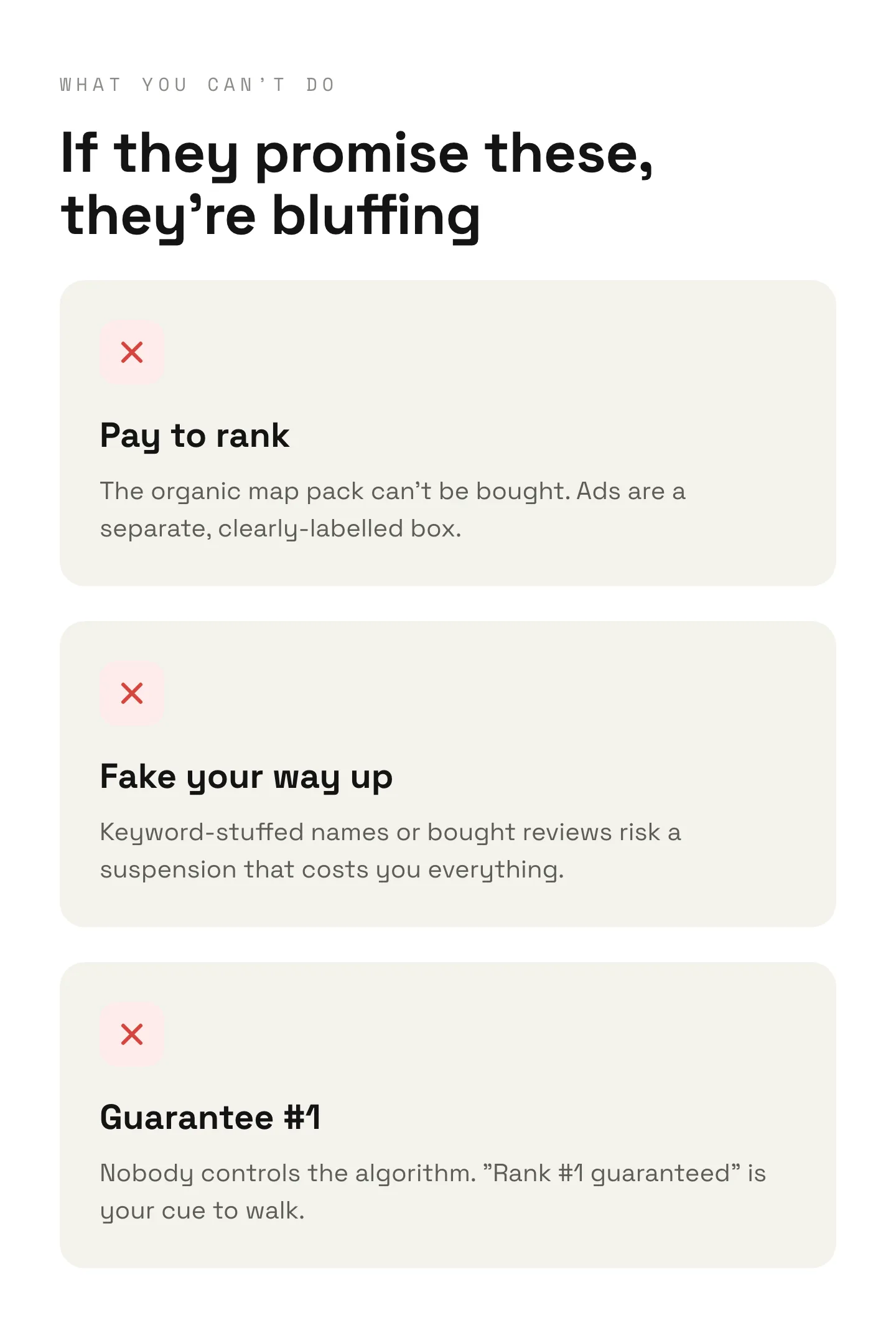
What you cannot do (and anyone who promises it is bluffing)
You cannot pay Google to rank higher in the map pack. Ads are a separate, labelled box, and if you are weighing up where that money is better spent, we have compared SEO vs Google Ads in detail. You cannot fake your way to the top with keyword-stuffed names or bought reviews without risking a suspension that costs you everything. And nobody can guarantee you the number one spot, because nobody controls the algorithm. If an agency promises “rank #1 guaranteed”, that is your cue to walk.
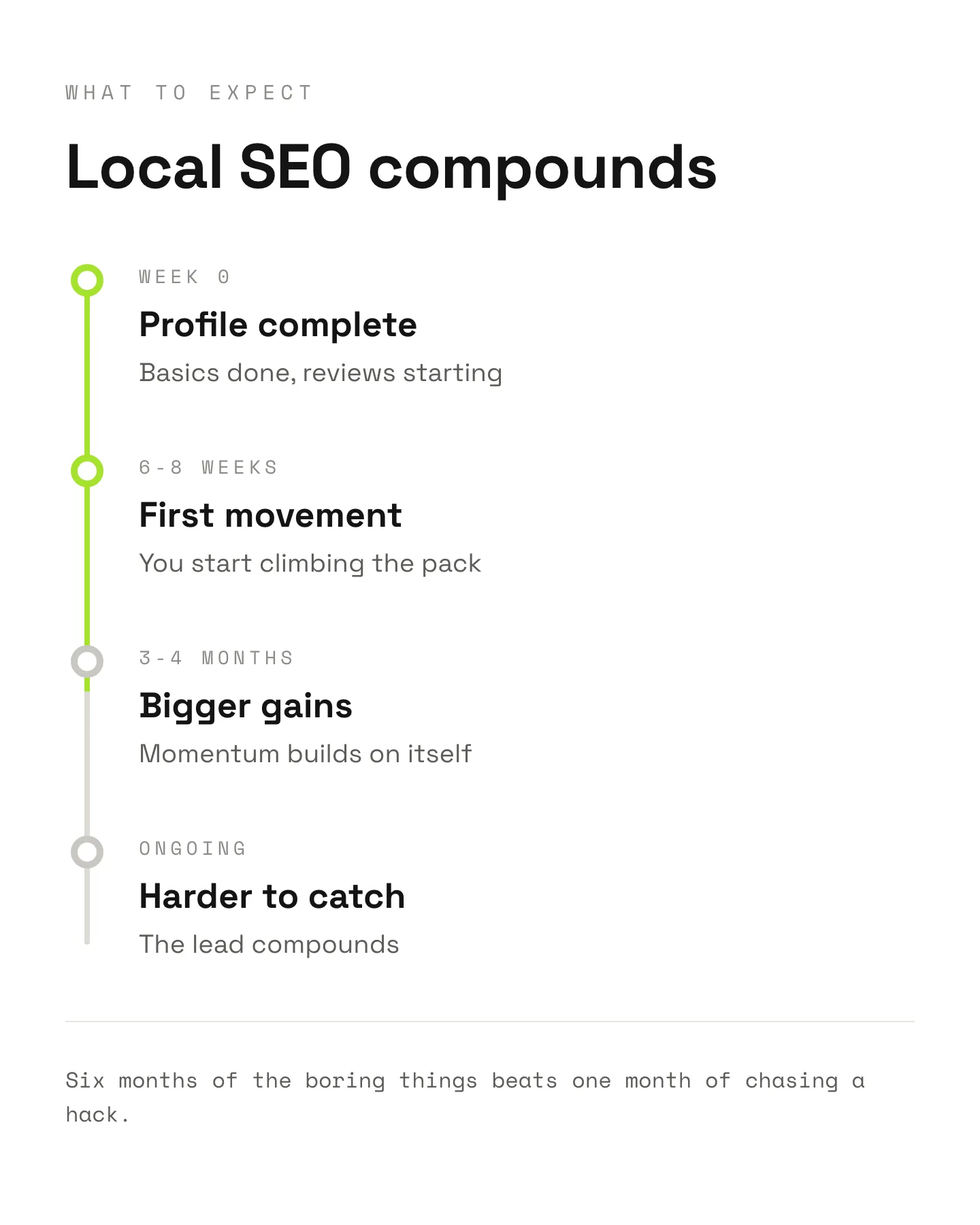
The businesses that win the map pack are the ones that finish their profile, earn reviews steadily, keep their details straight, and keep showing up. It compounds. Six months of doing the boring things beats one month of chasing a hack.
FAQ
How long does it take to rank higher on Google Maps?
Most local businesses see movement in 6 to 8 weeks once the Google Business Profile is complete and reviews start coming in steadily, with bigger gains over 3 to 4 months. Local SEO compounds, so the longer you keep at it, the harder you are to catch.
Is Google Business Profile the same as Google Maps?
They are linked. Your Google Business Profile is the free listing you manage, and it is what shows up in Google Maps and the local pack when people search. Fix the profile and you improve how you appear on the map.
Can I pay Google to rank higher in the map pack?
No. The organic map pack cannot be bought. You can run Local Services Ads or Google Ads, but those appear in a separate, labelled section. Ranking in the real map pack is earned through relevance and prominence.
Why is my competitor ranking above me on Google Maps?
Usually one of three things: they are closer to the searcher, their profile matches the search better, or they have more and better reviews. Proximity you cannot change, but relevance and reviews you can, and that is where the gap usually is.
If you have done all this and still are not appearing on the map at all, work through the basic reasons a business doesn’t show up on Google before anything else.
Not sure where your Google Business Profile stands? Book a free audit. We will check your profile, your rankings and your local setup, and tell you exactly what is holding you back. Yours to keep, whether you hire us or not. For the bigger picture, start with our plain-English guide to local SEO in Melbourne. And if you run a commercial cleaning company, this is the exact work our SEO for commercial cleaning service does week to week.